Why People Want to Be Seen Carrying Groceries
Erewhon turned the supermarket, one of the most ordinary places in modern life, into a status symbol.
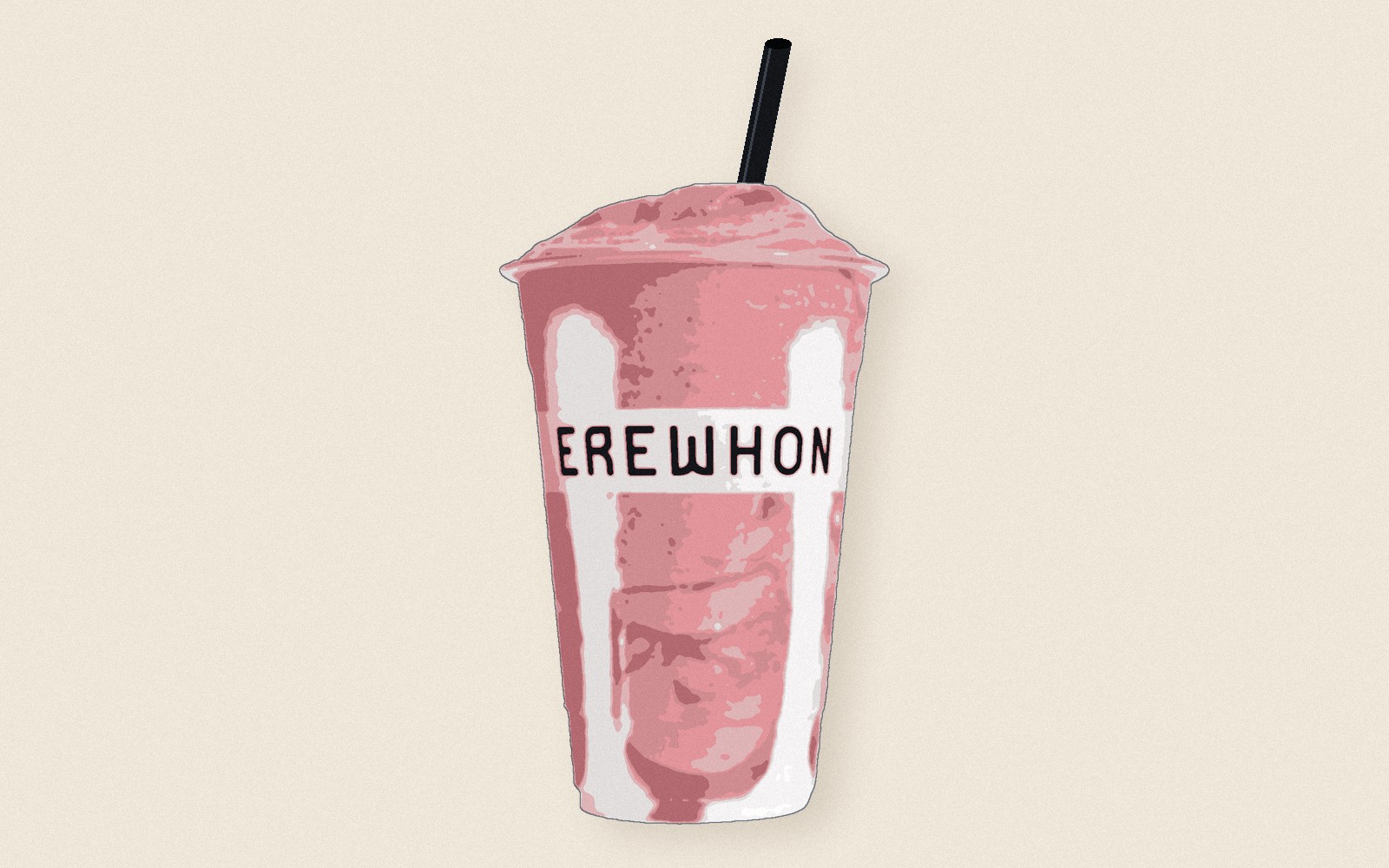
There is something strange about an Erewhon smoothie. Not the sea moss. Not the collagen. Not the blue spirulina, hyaluronic acid or whatever adaptogen happens to be having its moment. It is what people do after they buy it. They carry it around. They photograph it. They film themselves trying it. They take it into the car, onto the street, to Pilates, onto TikTok.
A grocery purchase becomes content. The clear plastic cup matters almost as much as what is inside it. That is unusual.
Nobody has ever carefully positioned their supermarket receipt beside their sunglasses for an Instagram Story. Nobody flies to Los Angeles and announces that one of the places they absolutely must visit is a normal grocery store. People do both with Erewhon.
The Los Angeles market has become a tourist attraction, celebrity hangout, wellness destination and piece of cultural shorthand for an entire version of Californian life. The Los Angeles Times described visitors treating Erewhon as both entertainment and a status experience; some tourists now stop there specifically to see products and wellness trends they cannot find elsewhere. (Los Angeles Times)
And underneath all of it is a remarkably simple strategy. Erewhon made consumption visible. It took groceries, products normally purchased privately, carried home and forgotten, and made buying them part of your identity.
A supermarket shouldn’t be aspirational
Luxury usually begins with things you do not need. A watch. A handbag. A sports car. Groceries are different. Everyone has to eat.
The supermarket is therefore one of the least exclusive spaces imaginable. Its traditional job is almost entirely functional: put food on shelves, make it easy to find, compete on price and convenience, get customers through the checkout. Erewhon violates almost every part of that formula.
Its stores are concentrated in some of Southern California’s wealthiest and most culturally visible neighbourhoods. Its shelves contain obscure supplements and emerging wellness brands. Its cafés serve elaborate prepared foods. Its tonic bars produce smoothies approaching $20. It sells branded merchandise. It runs paid memberships. Celebrities collaborate on drinks. By August 2026, Erewhon had opened its 15th location, in Thousand Oaks, after expanding into places including Beverly Hills, Venice, Santa Monica, Silver Lake, Calabasas, Manhattan Beach, West Hollywood and Glendale. (Los Angeles Times)
This no longer behaves like conventional grocery retail. It behaves more like a lifestyle brand that happens to contain vegetables. And that distinction explains almost everything.
It didn’t start this way
The irony is that Erewhon’s roots are almost the opposite of its current reputation. Michio and Aveline Kushi, pioneers of the macrobiotic movement, founded the business in Boston in the 1960s. They sold natural and organic foods at a time when brown rice, soy products and macrobiotic eating belonged firmly outside mainstream American culture. The business later moved to Los Angeles. (Erewhon)
The name itself came from Samuel Butler’s nineteenth-century novel Erewhon: an inversion of the word “nowhere.” For decades, Erewhon was essentially an earnest health-food store.
By 2011, the business had dwindled to a single remaining location on Beverly Boulevard. Tony and Josephine Antoci bought it that year. The store was hardly the polished temple of wellness people recognise today; contemporary reporting described it as cluttered and unremarkable in a city already full of health-conscious shoppers. (Los Angeles Times) The Antocis did not abandon the obsession with health.
They changed how health was presented. Stores became more polished. Merchandise became more tightly curated. Prepared food expanded. Cafés and tonic bars became central. Josephine Antoci took an unusually hands-on role in selecting what appeared on the shelves, personally reviewing prospective products. (Los Angeles Times) Then something happened outside Erewhon that made the model much more powerful.
Wellness became cool.
Health became a form of luxury
For most of the twentieth century, conspicuous consumption was easy to recognise. You demonstrated success by owning expensive things. The designer bag. The jewellery. The car. But status changes with culture. Today, in certain affluent circles, the things signalling that you are doing well are increasingly things suggesting that you are taking care of yourself unusually well.
Organic food. Pilates. Supplements. Matcha. Sleep optimisation. Cold plunges. Longevity clinics. Protein. A perfect morning routine. The body itself becomes a project.
Vogue has described the growing crossover between fashion, beauty and functional food, where wellness products increasingly act like lifestyle signals rather than merely nutrition. Erewhon has become one of the clearest physical expressions of that shift. (Vogue) Erewhon did not create wellness culture. It built perhaps the perfect retail stage for performing it. That is much more valuable.
The supermarket became part of the outfit
Think about an Erewhon cup. Transparent plastic. The name clearly visible. A brightly coloured drink inside. It leaves the store with you. That matters. Many supermarket purchases are invisible. The expensive olive oil disappears into a cupboard. Organic spinach goes into the refrigerator. Nobody outside your household knows what you bought. A smoothie is different.
It travels. It appears in your hand. And once a product becomes visible, it can perform an entirely different social function. A cup can tell people: I shop here. Which can quietly imply: I care about wellness. I know what is trending. I can afford this. I am part of this particular cultural world. The mechanics are remarkably similar to fashion.
A logo on a handbag lets an object communicate affiliation. Erewhon discovered that a grocery-store cup can do something surprisingly close. This is why saying “it’s just an overpriced smoothie” misses the strategy. If customers were evaluating it solely as blended fruit, $20 would be absurd. But they aren’t necessarily purchasing only blended fruit. They are buying a little piece of Erewhon.
Then came the smoothie
Erewhon’s most brilliant marketing object was not a billboard or advertising campaign. It was something you could drink. Celebrity and influencer smoothie collaborations existed before Hailey Bieber’s, but the format exploded in 2022. In March, influencer and Summer Fridays co-founder Marianna Hewitt collaborated with Erewhon on the Coconut Cloud Smoothie. Erewhon executive Vito Antoci later said that collaboration revealed the scale of what the category could become.
Then, in June 2022, came Hailey Bieber’s Strawberry Glaze Skin Smoothie, tied to the launch world surrounding Rhode. It became enormous.
Erewhon said roughly 36,000 were sold in the first month. By 2023, it was selling around 1,200 to 1,500 a day, and Fast Company subsequently reported roughly 40,000 a month, generating an estimated $10.6 million from that single smoothie variant over the period it examined. (Forbes) By 2024, Josephine Antoci told the Los Angeles Times that Erewhon was selling approximately 45,000 to 50,000 Strawberry Glaze Skin Smoothies each month across its stores. (Los Angeles Times)
A supermarket drink had begun behaving like a beauty drop. And that is the important part.
Erewhon turned the smoothie into media
The typical brand collaboration works like this: A company pays a celebrity. The celebrity appears in an advertisement. Consumers see the advertisement. Some buy the product. Erewhon’s model is more interesting. The product itself becomes the advertisement. A celebrity creates a drink. Fans travel to Erewhon to try it. They photograph it. They post reviews.
People film themselves recreating it. Food accounts discuss the ingredients. Beauty publications cover it because the collaborator has a skincare brand. Fashion publications cover it because the celebrity is a fashion figure. TikTok debates whether it is worth the price. Other celebrities are photographed holding one. And thousands of customers become the distribution network. Each smoothie leaving the shop is essentially a tiny mobile billboard that someone has paid Erewhon for the privilege of carrying.
That is an extraordinary reversal. Traditional advertising costs money when somebody sees it. Erewhon has created products that generate both revenue and attention at the same time.
The $20 price helps
This is where Erewhon’s pricing becomes more interesting than simply “expensive.” The outrageousness is useful. If the smoothie cost $6, it would be a smoothie. At $18 or $20, it becomes something to discuss. “Would you pay $20 for this?” is itself a piece of content. The price produces outrage, curiosity, jokes, reaction videos and headlines.
And yet, and this is the clever part, it is still accessible relative to traditional luxury. Most people cannot casually buy a $3,000 designer bag because they saw Hailey Bieber carrying one. A much larger group can spend $20 once. That makes Erewhon a form of micro-luxury. You may not live in a $15 million house in Malibu.
You may not have the Range Rover. You may not wear The Row. But for twenty minutes, you can drink the same absurd pink smoothie. Vogue’s analysis of Erewhon’s business described precisely this tension: the store can feel highly exclusive while still giving a much wider group of consumers an attainable entry point into the lifestyle it represents. (Vogue)
That may be the most powerful part of the entire model. Erewhon sells proximity to luxury without requiring luxury-level spending. Not cheaply. Just accessibly enough.
The absurdity is part of the attraction
The internet loves Erewhon’s prices. A single strawberry going viral for $19. Expensive water. Prepared foods that become debates. The recurring genre of TikTok content is practically built into the business: “Guess how much this costs at Erewhon.” From a conventional retailer’s perspective, this sounds terrible. Why would you want thousands of people mocking your prices?
Because everyone now knows your name. Erewhon’s high prices function partly as a boundary. They communicate that this is not simply another supermarket. The criticism reinforces the positioning. Someone saying, “Who would ever pay that?” and someone responding, “I need to try it,” are participating in the same marketing system. Indifference would be far more dangerous.
But virality alone doesn’t explain it
Plenty of ridiculous products go viral once. Erewhon has built something much stickier because underneath the internet theatre is an unusually strong habit business. Its cafés and tonic bars matter enormously. Traditional supermarkets depend heavily on the weekly shop. Prepared food changes the frequency. You can visit Erewhon because you need groceries. But you can also visit because you want lunch.
Or a smoothie. Or breakfast. Or a coffee. Or something after Pilates. Or because you are meeting someone. Or because you simply want to browse. That turns the grocery store from a weekly utility into something closer to a daily ritual.
In 2025, Erewhon said its all-day cafés occupied roughly 30% of store floor space and served about 100,000 customers every week. Earlier reporting had found prepared foods and private-label products accounting for a substantial share of the business. (Los Angeles Times) That is a critical piece of the strategy. The smoothie creates attention. The café creates frequency.
The shelves monetise the traffic. And the culture binds everything together.
It is a supermarket designed to linger in
Traditional supermarkets are rarely places you want to stay. The optimal experience is frictionless. Get in. Find what you need. Pay. Leave. Erewhon behaves differently. There are cafés. Patios. Tonic bars. People eating lunch. People working. People watching other people. Celebrities occasionally appearing. Products worth browsing even if you have never heard of them. The store has become part market, part restaurant and part social environment.
The Los Angeles Times has described it as a date spot, post-workout hangout, tourist destination and selfie backdrop in addition to being a grocery store. (Los Angeles Times) That means Erewhon competes not only with Whole Foods. It competes with a café. A members’ club. A wellness destination. A fashion store. A restaurant. And occasionally, a tourist attraction.
Once you change the category in people’s heads, conventional supermarket pricing comparisons become much less useful.
Curation makes the shelves feel valuable
There is another clever element hidden behind the absurd smoothies. Erewhon does not want to feel infinite. It wants to feel selected. Josephine Antoci has become central to this. The company receives products from brands hoping to secure shelf space, and she has described personally reviewing what Erewhon carries. (Los Angeles Times) That changes the psychological role of the supermarket.
At a huge conventional retailer, the customer does the filtering. Fifty protein bars. Thirty waters. Twenty supplements. You decide. At Erewhon, part of the promise is: We already found the interesting thing. That makes the shelves resemble a concept store.
And for small wellness brands, appearing there can become a cultural signal of its own. Vogue reported that emerging consumer brands often consider the visibility and prestige of Erewhon distribution valuable despite the costs associated with selling through the retailer. (Vogue) This produces another flywheel. Interesting brands want Erewhon. Therefore Erewhon gets interesting brands. Therefore consumers visit Erewhon to discover them.
Therefore appearing in Erewhon becomes even more desirable. A supermarket becomes a tastemaker.
The membership makes it feel even more like a club
Then Erewhon adds another layer. Membership. As of 2026, its programme includes paid tiers, with its Select membership priced at $100 per year and Signature at $200, alongside additional membership levels. Members earn points and receive various benefits and offers. (Erewhon) A supermarket does not need a membership programme to sell you kale. But Erewhon is not simply trying to sell you kale.
Membership turns a customer into a member. The language matters. The psychology matters. You no longer merely shop there. You belong there. It is another small shift away from supermarket behaviour and toward hospitality, fitness clubs and luxury ecosystems. Erewhon has spent years taking the basic ingredients of grocery retail and changing their meaning. A shop becomes a destination.
A shopper becomes a member. A drink becomes a collaboration. A plastic cup becomes a status signal. A supermarket shelf becomes curation.
It borrows from fashion more than food
This may be the easiest way to understand Erewhon. Look at the playbook. Limited-time collaborations. Celebrity creative partners. Branded merchandise. Drops. Scarcity. Cultural relevance. Beautiful physical environments. Highly recognisable packaging. Extreme pricing that itself generates conversation. Association with certain neighbourhoods and certain people. These are not traditional supermarket tools. They are fashion tools.
Erewhon has collaborated across culture with names and brands far outside grocery, including Balenciaga, Ugg and a stream of celebrities, beauty founders and creators. Vogue has described it as increasingly occupying the territory between grocery, fashion, wellness and entertainment. (Vogue) That is why copying Erewhon by simply selling a $20 smoothie probably would not work.
The drink is not the strategy. It is an output of the strategy. The strategy is constructing a world that people want to identify with, and then producing small objects they can carry out of that world.
Erewhon is selling a version of Los Angeles
There is also something deeply geographical about the brand. You cannot fully separate Erewhon from Los Angeles. Sunlight. Wellness. Celebrities. Pilates. Beauty. Biohacking. Organic food. Athleisure. A particular obsession with looking both healthy and effortless. Erewhon compresses all of those associations into a retail experience.
For years, that concentration was an advantage rather than a limitation. Stores remained largely within Los Angeles and its immediate cultural orbit, allowing Erewhon to become intensely associated with one place instead of immediately attempting to become everywhere.
Even as the company now accelerates expansion across Southern California, it remains cautious about moving beyond its home market. Its newest Thousand Oaks store, opened in August 2026, was its 15th, while further sites are planned for downtown Los Angeles and Costa Mesa in 2027. (Los Angeles Times) There is an interesting strategic tension here.
Erewhon is famous enough to be global. Its physical footprint still isn’t. That gap creates desire. Millions of people see Erewhon online without having an Erewhon nearby. So visiting one becomes something you do when you go to LA. The inconvenience itself preserves part of the mythology.
Which creates Erewhon’s biggest problem
What happens when everyone can have it? Luxury businesses live with this question constantly. Growth is attractive. Ubiquity is dangerous. Open too few stores and you leave enormous demand untapped. Open everywhere and the thing that made people care can disappear. Erewhon is now entering that stage. The company has explicitly described its current expansion phase as “Erewhon 2.0.” It opened several locations through 2025 and 2026 and has further expansion planned. (Los Angeles Times)
The challenge is not whether Erewhon can sell groceries in more places. Of course it can. The question is whether Erewhon can scale desirability. If you can find one on every corner, does carrying the cup still communicate anything? If every influencer has a smoothie, does having one still feel special? If the shelves fill with brands already available everywhere else, is the store still a discovery engine?
This is the same problem fashion brands face when they become too successful. And perhaps that alone tells you what Erewhon has become. A supermarket now has to worry about overexposure.
The lesson isn’t “charge $20 for a smoothie”
That would be the easiest, and least useful, conclusion. Erewhon works because the expensive smoothie sits inside an entire system. The environment makes the price believable. The curation makes discovery valuable. The celebrity collaborations create attention. The prepared food creates frequency. The limited footprint creates aspiration. The customer creates the social media. And the visible packaging lets the purchase travel beyond the shop.
The transferable idea is much more interesting: Ask whether your product stops being valuable once the transaction is over, or whether the customer can continue signalling something by owning, carrying or using it. Most grocery products disappear after purchase. Erewhon designed some of its most culturally powerful products to do the opposite. They become visible.
And visibility creates marketing.
The cheapest luxury product might be lunch
Traditional luxury asks consumers to save for the object. Erewhon asks for twenty dollars. That creates an almost perfect modern indulgence. Small enough to repeat. Expensive enough to feel special. Photogenic enough to share. Recognisable enough to signal. Temporary enough that you can justify another one tomorrow. A handbag may last ten years. The smoothie disappears in twenty minutes.
Which means Erewhon gets to sell the feeling again. And again. And again. That may be why the Erewhon phenomenon matters far beyond grocery. It shows that almost any category, even one as functional as food shopping, can become aspirational when the product is embedded inside the right culture. The company did not invent expensive groceries.
It did something much smarter. It made people want other people to know where their groceries came from.
Why It Works
Erewhon turned consumption into identity.
The smoothie is not merely a drink. The store is not merely a supermarket. And the customer is not merely buying food. For twenty dollars, they are buying a small, visible piece of a world they want to belong to.
Erewhon made groceries something you could wear.